 Aug 26, 2026
Most people judge a business by its website before they speak to anyone there. That makes choosing w[...]

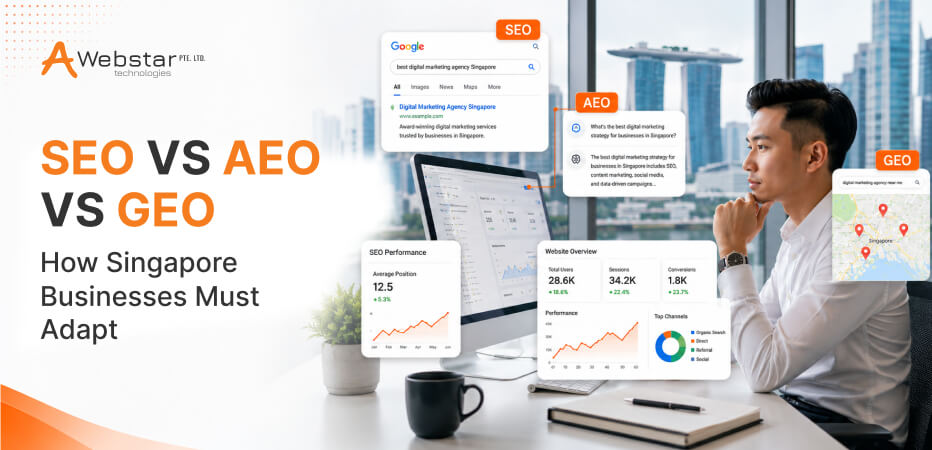
SEO helps your website rank in Google and Bing search results. AEO (Answer Engine Optimisation) helps your content get selected as the direct answer in featured snippets, voice search, and Google’s AI Overviews. GEO (Generative Engine Optimisation), sometimes called AI SEO, LLM SEO, or LLM optimisation, goes a step further, helping your brand get cited, quoted, and recommended inside AI-generated responses from tools like ChatGPT, Gemini, and Perplexity. In 2026, businesses need all three SEO, AEO, and GEO to stay visible wherever their customers are searching.
So what’s the real SEO vs AEO difference, and where does GEO fit in? SEO has always been about ranking organic search results. AEO is about how a single answer gets pulled out and served directly to the user. GEO is about whether AI models choose to reference your brand at all, shaping how you’re represented long before anyone ever clicks a link.
This shift is happening globally, but businesses operating in Singapore are especially exposed to it. Companies that don’t keep up with the latest AI search trends risk losing visibility, traffic, and ultimately customers to competitors who do. So if you’ve been asking “how to rank in AI search results,” understanding how to optimise for AI search through SEO, AEO, and GEO together is no longer optional.
SEO is the practice of improving your website’s visibility in traditional search engines like Google and Bing. It relies on:
At its core, SEO exists to bring people to your website.
AEO is the practice of structuring content so it can be pulled out and served as a direct answer in a featured snippet, a voice search result, or Google’s AI Overview. AEO focuses on concise answers, clear structure, and topical authority, rather than simply ranking a page.
GEO is the newest layer, and increasingly the most important one. It’s the practice of optimising your brand’s presence so that generative AI tools, such as ChatGPT, Gemini, Perplexity, and Claude, choose to mention, cite, or recommend you when answering a user’s question. Unlike AEO, GEO isn’t about winning a single search result; it’s about how consistently and accurately your brand appears across the sources these models draw from, including structured data, review sites, forums, and knowledge bases like Wikipedia. Get this right, and your brand becomes part of the answer, even when nobody visits your website at all. Working with a dedicated GEO and AI SEO agency in Singapore can help you get these signals right faster.
| Aspect | SEO | AEO | GEO |
|---|---|---|---|
| Goal | Rank on search engines | Be selected as the direct answer | Be cited or recommended in AI-generated responses |
| Focus | Keywords & backlinks | Context, clarity & structure | Entity authority, structured data & brand consistency |
| Outcome | Website clicks | Featured snippets & voice answers | AI citations & AI brand visibility |
| Format | Long-form content | Structured, answer-first content | Fact-dense, well-sourced, quotable content |
| Key platforms | Google, Bing | Featured snippets, Siri, Alexa, Google Assistant | ChatGPT, Gemini, Perplexity, Google AI Overviews |
Understanding this SEO vs AEO vs GEO difference is the first step toward building a search strategy that’s ready for 2026 and beyond.
AEO and GEO’s importance for businesses will only keep growing as AI reshapes how people search.
AI-powered platforms have transformed user behaviour. People now expect accurate answers instantly, without visiting multiple websites to find them. AEO and GEO exist to make sure your content and brand are part of that answer, not left out of it.
A few shifts are driving this:
For business owners in a competitive market like Singapore, the window to capture your audience’s attention is shrinking fast unless your content and brand presence are properly optimised for AI visibility and AI discoverability.
AI-powered search relies on natural language processing. Instead of typing a short keyword like “best website design Singapore,” users now ask full questions like “which company provides affordable website design in Singapore?” Search engines and AI tools have adapted accordingly; content built around clear, conversational Q&As now outperforms content built purely around keywords.
AI engines weigh several factors when deciding what to surface:
Content that’s well-organised and directly answers user intent has the best chance of being selected for AEO and of being remembered and referenced for GEO.
AI-assisted search now spans multiple platforms:
Your content needs to be optimised well beyond a traditional Google ranking; it needs to work across every platform where your audience is asking questions.
This guide covers actionable steps you can put in place immediately to improve how your content and brand perform across AI-powered search platforms.
Answer the user’s question directly and concisely within the first 40–60 words, then expand with more detail further down the page. Use question-based headings such as:
Well-structured content is far more likely to be picked up by AI systems. This is the essence of AI content optimisation: use bullet points and numbered lists, a clear heading hierarchy (H2, H3), and a dedicated FAQs section, the same fundamentals covered in a solid on-page SEO checklist.
Build clusters of connected content around your core services, for example, website design and website development, and SEO/AEO/GEO, and link these pages together to signal authority to both search engines and AI models.
AI understands topics through context and entities, not just keywords. This is where Entity SEO and Semantic SEO come in, helping AI systems correctly associate your brand with:
The more consistently this information appears across your site and the wider web, the easier it is for AI to connect your brand to the right topics.
People speak and type more naturally with voice search and AI tools than they do with traditional search. Write your content the way you’d naturally answer the question out loud.
Schema markup helps AI systems recognise and correctly interpret the content on your site, a key part of structured data for AI and Knowledge Graph optimisation. Add:
GEO depends on more than your own website. AI models draw on third-party sources, too, such as reviews, directories, forums, and industry publications. Building a consistent, accurate presence across these sources is what ultimately helps your business get cited by AI and improves your overall AI brand visibility.
Put these steps into practice, and your business will be far better positioned to rank and get cited across every AI-powered search platform that matters.
Voice search continues to grow rapidly alongside the adoption of mobile and smart devices.
Effective voice search SEO strategies include:
Voice search queries also tend to be longer and more conversational than typed searches, so your content should match that natural tone.
SEO continues to deliver value by providing:
Ultimately, both AEO and GEO depend on strong SEO. AI systems still pull much of their information from indexed, well-optimised, reputable web pages, so without solid SEO as the foundation, AEO and GEO can’t succeed either. A hybrid strategy is essential.
Neglecting any one of the three will limit your overall growth potential.
Successful organisations in 2026 will combine:
This hybrid approach delivers maximum visibility across traditional search, AI answers, and generative AI responses alike.
Follow these steps to improve how your business ranks and gets cited in AI search results:
Consistently applying this process is what helps businesses maintain strong, lasting visibility in AI search results.
AEO and GEO open up real opportunities, but they come with genuine challenges too:
Businesses need to monitor and adapt their approach continuously as these platforms evolve.
AI-powered search is evolving fast, and the pace shows no sign of slowing. Key trends to watch include:
Businesses that adapt early will hold a significant competitive advantage and capture greater market share.
To stay competitive, companies will need to:
The move toward AEO and GEO isn’t a replacement for SEO; it’s the next stage in how search is evolving. Both AEO and GEO depend on the foundation SEO provides, since AI systems still need well-indexed, structured, and credible content to select from and cite.
For Singaporean businesses wanting to lead in 2026 and beyond, integrating SEO, AEO, and GEO together is what will drive search visibility, attract customers, and create lasting success. Don’t choose between SEO, AEO, and GEO; integrate all three.
Awebstar Technologies offers advanced digital marketing services built around AI systems. Our team works with you to enhance your online performance, whether that means improving your search engine rankings, optimising for AI-generated answers, or building your visibility inside generative AI tools like ChatGPT and Gemini through our GEO and AI SEO services, alongside creating a fast, functional website that supports it all.
Contact Awebstar Technologies now to learn how we can help you excel at search engine optimisation, answer engine optimisation, and generative engine optimisation in 2026 and beyond!
Aug 26, 2026
 Jul 21, 2026
 May 14, 2026
We'd love to hear from you! Send us a message or Call us, and we'll be happy to set up a time to understand your needs better.