 Oct 27, 2026
School ERP System: Key Modules and Implementation Steps School administrators juggle admissions, tim[...]

Late orders, idle machines and piles of half-finished work usually point to the same root cause. The factory is not planning and tracking work in a structured way. Experienced supervisors can keep things moving for a while, but that approach struggles as volumes and product variety grow.
This guide explains the planning and control process step by step. It then shows which software tools support each stage.
Every factory must balance customer demand against limited machines, labour and materials. Production planning and control (PPC) is the function that manages this balance. Planning sets targets and the sequence of work before production starts. Control monitors progress and corrects deviations as work moves through the shop floor.
Many manufacturers call this team PPIC, which adds inventory control to its scope. The goal stays the same: deliver on time at the lowest practical cost.
A well-run planning function serves several goals at once. The main ones are:
Planning methods depend on how a factory makes its products. The three main production types each need a different focus:
Many factories combine these types, such as batch processing followed by custom finishing.
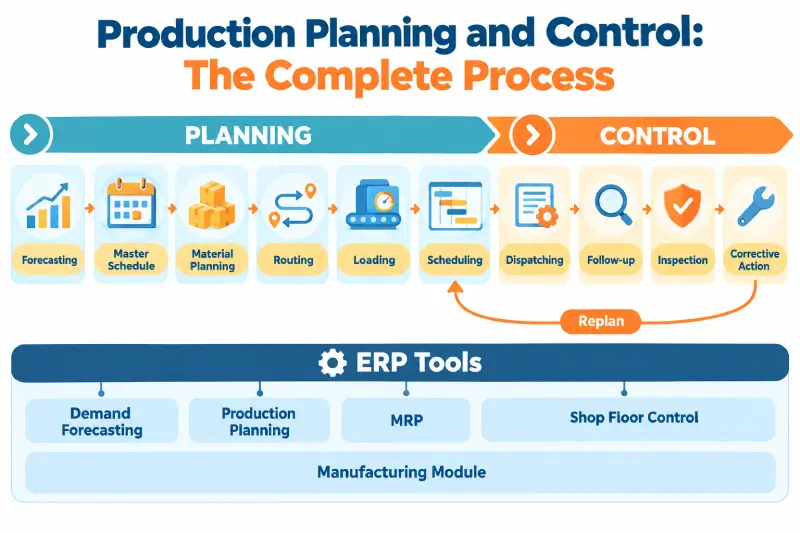
The process splits into a planning phase and a control phase. Each phase contains several linked steps that feed into one another.
Many small and mid-sized factories still plan in spreadsheets and on whiteboards. Manual production planning and control works when demand is stable and product variety is low. It fails when orders change daily and planners cannot see live stock or machine status. Typical symptoms include:
Software does not replace planning judgement. It gives planners accurate data and removes manual calculation. The main ERP functions map directly to the steps above. Before buying, check that your bills of materials and routings are accurate, because every plan depends on them.
Forecasts start with clean sales data. ERP demand forecasting analyses order history, seasonal patterns and open quotations to project future volumes. Planners can then adjust forecasts using market knowledge before they feed the master schedule.
Planners need to see whether the factory can deliver what sales has promised. ERP production planning tools build the master schedule and compare it with work centre capacity. Overloaded periods show up clearly, so planners can shift jobs or add shifts in advance.
Material shortages often delay production even when machines and labour are free. ERP MRP breaks each product’s bill of materials into component requirements across the planning horizon. It then nets these against stock and open orders to suggest purchase and work orders.
Plans only work if planners know what is happening on the floor. ERP shop floor control captures job start and finish times, output quantities and scrap through terminals or mobile devices. Supervisors see live progress against the schedule and react before delays spread.
These tools work best when they share one database. An ERP manufacturing module links bills of materials, routings, work orders, inventory and costing. Finance then sees actual production costs without manual reconciliation.
Metrics show whether planning decisions work in practice. Strong production planning and control should move these numbers in the right direction over time. Track them monthly:
Effective planning starts with clear demand, accurate stock data and realistic capacity figures. The control phase then keeps work on track through dispatching, monitoring and quick corrections. Factories still relying on spreadsheets for production planning and control should start by connecting forecasts, materials and shop floor data. If you are reviewing options, Awebstar can help you scope manufacturing ERP software around your current workflows.
Planning decides what to make, when and with which resources. Control monitors actual progress and corrects deviations from the plan.
PPIC stands for Production Planning and Inventory Control. It combines production scheduling with management of raw materials, work-in-progress and finished goods.
MRP calculates material requirements for production. ERP includes MRP plus finance, sales, purchasing, inventory and other business functions in one system.
It depends on your production type. Backward scheduling suits make-to-order work with fixed due dates, while forward scheduling suits make-to-stock environments.
Yes. Even small factories gain from accurate material planning and live job tracking. Cloud ERP options also reduce upfront costs for smaller operations.
Oct 27, 2026
 Oct 27, 2026
 Oct 27, 2026
We'd love to hear from you! Send us a message or Call us, and we'll be happy to set up a time to understand your needs better.